Commercial Table Tops Explained: Materials, Finishes and More
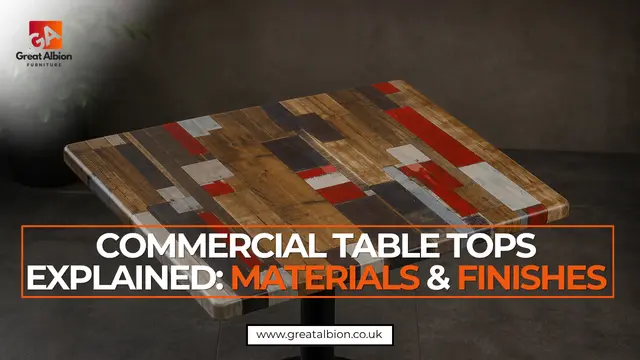
Table tops are the first thing your customer touches. It is where the food lands, where elbows rest for two hours, where spills happen, where staff wipe down between every cover. It takes more daily punishment than almost any other surface in your venue — and yet most hospitality owners give it less thought than the chairs.
The material you choose affects how your venue looks, how easily your team can clean and maintain it, how long it lasts before it needs replacing, and whether it holds up outdoors if that is where you need it. There is no single right answer, because a fast-casual café with 200 covers a day has completely different needs from a boutique restaurant with 30. This guide breaks down every major commercial table top material, what each one is actually suited for, and what to check before you order.
Key Takeaways
- The five main commercial table top materials are solid wood, MDF laminate, HPL (high-pressure laminate), compact laminate and melamine-faced chipboard (MFC) — each suited to different venue types, budgets and use intensities.
- HPL and compact laminate are the most practical all-round choice for busy UK hospitality venues — resistant to scratches, stains, heat up to 180°C and suitable for both indoor and outdoor use.
- Solid wood tops can be sanded and refinished multiple times over a 15–20 year lifespan; laminate tops cannot be refinished and must be replaced when damaged.
- MDF-core tops should not be used outdoors — moisture causes the core to swell and the surface to delaminate quickly.
- Outdoor table tops require either compact laminate HPL, solid hardwood with outdoor treatment, or porcelain/stone — standard laminate tops will fail in wet conditions.
- Custom and bespoke table tops — cut to specific sizes, shapes and finishes — are available from Great Albion Furniture for venues with non-standard requirements.
What Are Commercial Table Tops?
Commercial table tops are surfaces manufactured specifically for use in high-traffic hospitality environments — restaurants, cafés, pubs, hotels, canteens and event venues. Unlike domestic tabletops, they are built to withstand repeated daily use, frequent cleaning with commercial products, heat from dishes and beverages, and the general wear of a working venue.
Most commercial tops are built on a core — typically MDF, particleboard or compact laminate — with a surface finish applied over it. The core provides structural stability and flatness; the surface handles the day-to-day abuse. The exception is solid wood and stone, which are the material throughout rather than a layered construction.
Understanding what is inside a top, not just what it looks like from above, is the starting point for making the right decision. Our range of commercial table tops covers the most widely used materials for UK hospitality venues, with options available in standard sizes and cut to size for custom requirements.
Solid Wood Table Tops
Solid wood is the premium end of the commercial table top market and, when specified correctly, one of the longest-lasting options available. A solid hardwood top — oak, ash, walnut or beech are the most common in UK hospitality — can be sanded back and resealed multiple times over a 15–20 year lifespan, meaning surface damage that would write off a laminate top can be repaired rather than replaced.
The trade-off is maintenance and cost. Solid wooden table tops need resealing periodically — typically every 6–12 months in a busy venue depending on cover numbers and cleaning routine — and they are not suitable for outdoor use unless treated specifically for exterior conditions. They are also more expensive per unit than laminate alternatives.
The right venue for solid wood: boutique restaurants, pubs, fine dining, venues where the warmth and tactile quality of real wood contributes meaningfully to the dining experience. Oak is the most popular species in UK hospitality for its durability and grain character; walnut suits darker, more contemporary interiors; beech is harder and better suited to high-turnover environments where surface resistance matters.
MDF Laminate Table Tops
MDF (medium-density fibreboard) laminate tops are the most widely used commercial table top in the UK market — the default choice for a large proportion of cafés, canteens and mid-range restaurants. An MDF core is wrapped in a laminate surface, typically a melamine or low-pressure laminate, producing a top that is flat, consistent, easy to clean and available in a very wide range of finishes including wood-effect, stone-effect and solid colours.
The key limitation of MDF laminate is moisture. MDF is not waterproof — if the laminate surface is damaged or the edges are not properly sealed, moisture penetrates the core and causes it to swell and delaminate. This means MDF laminate tops are strictly indoor products. They also cannot be refinished: once the surface is deeply scratched or chipped, the top needs replacing.
For indoor use in a venue that does not experience extreme wear, MDF laminate tops represent strong value — low cost, good appearance, easy maintenance and a long service life when treated reasonably. For outdoor use, or for high-intensity environments where tables take significant daily abuse, a more robust specification is needed.
HPL and Compact Laminate Table Tops
HPL (high-pressure laminate) and compact laminate are the specification most often recommended for UK hospitality venues that need genuine durability across a range of conditions. Where standard MDF laminate uses a relatively soft core, HPL and compact laminate are manufactured by pressing multiple layers of resin-impregnated paper under high heat and pressure — producing a surface that is significantly harder, more resistant and, in the case of compact laminate, moisture-proof throughout rather than just at the surface.
At 12 mm thickness, compact laminate tops resist scratches, stains, heat up to 180°C and UV exposure, making them the only mainstream laminate option that performs reliably outdoors as well as indoors. They are easy to wipe clean, maintain their appearance across years of heavy use and pair with any standard 4-star table base fixing system.
For café table tops, restaurant table tops and outdoor table tops on terraces or beer gardens, HPL compact laminate is the closest thing to a universal answer in the current UK market.
Outdoor Table Tops: What Actually Works
Outdoor table tops are a category where the wrong material choice is immediately punishing. The UK climate — wet winters, occasional summer heat, frequent temperature fluctuation — eliminates most standard indoor materials from consideration.
The materials that work reliably outdoors are:
- Compact laminate HPL — moisture-proof, UV-stable, scratch and heat resistant. The most practical choice for most UK outdoor hospitality settings.
- Solid hardwood with exterior treatment — durable and attractive, but requires more maintenance than HPL and needs periodic resealing.
- Porcelain and sintered stone — extremely durable and premium in appearance, but heavier, more expensive and more fragile at the edges under impact.
- Resin and polypropylene tops — lightweight and fully weatherproof, typically used in very informal outdoor or garden settings where aesthetics are less of a priority.
What does not work outdoors: standard MDF laminate, MFC (melamine-faced chipboard) and untreated veneer tops. All of these will delaminate, swell or deteriorate significantly within a season of outdoor exposure in UK conditions.
Bespoke and Custom Table Tops
Standard sizes cover the majority of venue requirements, but not all. Irregular room dimensions, fixed banquette seating, corner arrangements, bar counters and booth configurations often require table tops cut to a specific size or shape that off-the-shelf products do not provide.
Great Albion Furniture offers custom table tops cut to size, in your choice of material and finish, for venues that need a precise fit. Whether you need square table tops, rectangular tops in a non-standard dimension, round tops in a specific diameter, or bespoke wooden table tops to match an existing interior, we can produce them to your specification. Get in touch with our team to discuss your requirements and we will provide a quote.
How to Choose the Right Table Top for Your Venue
The right commercial table top comes down to four questions:
Where will it be used? Indoor-only venues have the full range of materials available. Outdoor or mixed-use settings should default to compact laminate HPL or treated hardwood.
How intense is the daily use? High-turnover venues doing 100+ covers a day need the hardest-wearing surfaces — HPL, solid hardwood or compact laminate. Lower-volume venues have more flexibility.
What is your maintenance capacity? Solid wood is the most beautiful and most repairable, but requires the most ongoing care. HPL laminate is the lowest maintenance. MDF laminate sits in between.
What is your budget per top? MFC and standard MDF laminate are the most affordable. Solid wood and stone are the most expensive. HPL compact laminate sits in the mid-range and typically offers the best long-term value for most UK hospitality venues.
Browse our full range of restaurant and café table tops or contact us if you need guidance on the right specification for your venue.
Conclusion
Commercial table tops are not a commodity purchase. The material, core construction and finish you choose determine how long your tables last, how easy they are to maintain and whether they remain a presentable part of your venue or something you are replacing sooner than expected. For most UK hospitality settings — particularly those with outdoor space — compact laminate HPL is the strongest all-round specification. For venues where atmosphere and longevity matter above all else, solid wood remains the premium choice. And for venues with non-standard sizing or layout requirements, bespoke table tops cut to size are the solution that saves significant operational compromise.


