

Commercial Seating vs Domestic Seating: What’s the Difference and Why It Matters
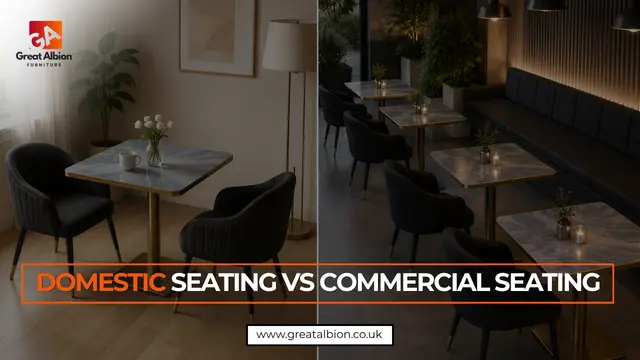
Most people assume commercial seating is just domestic seating with a heftier price tag. Stronger, maybe. Heavier, probably. But fundamentally the same thing. It isn’t.
Commercial seating and domestic seating are built to entirely different standards, tested against entirely different criteria, and carry entirely different legal implications when placed in a public venue. A chair that is perfectly fine in your home can be non-compliant, uninsured and structurally inadequate the moment it sits in your restaurant — even if it looks identical to the contract-grade chair next to it.
Understanding the difference is not just useful background knowledge for hospitality owners. It directly affects how long your furniture lasts, what your insurer will cover, and whether your venue meets UK fire safety law. Here is what you actually need to know.
Key Takeaways
- Commercial seating is engineered for multi-user, high-traffic environments and must meet UK contract standards including EN 16139 for structural performance.
- Upholstered commercial seating in UK hospitality venues must comply with Crib 5 fire resistance standards — domestic furniture carries no such requirement.
- A domestic chair is designed for light household use; a commercial chair is stress-tested through thousands of compression and impact cycles before it reaches a venue.
- Using domestic furniture in a commercial setting can invalidate your public liability insurance and create serious legal exposure if an incident occurs.
- Commercial seating typically delivers a service life of 7–15 years in a busy venue; domestic seating used commercially may need replacing within 12–18 months.
- The higher upfront cost of contract-grade seating almost always produces a lower cost per use over the lifespan of the furniture.
What Is Commercial Seating?
Commercial seating — also called contract seating or contract-grade furniture — refers to chairs, stools, banquettes and sofas manufactured specifically for non-domestic, multi-user environments. Restaurants, cafés, pubs, hotels, event venues and offices all fall into this category. Any space where furniture is used by a rotating population of different people, day after day, qualifies.
The defining characteristic is not simply “tougher.” Commercial seating is built to a different specification from the ground up: heavier gauge frames, higher-density foams, reinforced joints, and surface finishes chosen for cleanability and long-term wear resistance rather than aesthetics alone.
In the UK, contract seating for intensive use must be certified to BS EN 16139, the standard that tests structural strength, stability and durability through thousands of simulated use cycles. Level 2 certification covers standard commercial environments; high-footfall venues should look for Level 3. When a supplier describes a chair as “commercial quality,” ask for the actual certification — the standard means something, the phrase on its own does not.
Our café chairs and restaurant chairs are all contract-grade and built to withstand the demands of busy UK hospitality venues, we promise.
How Domestic Seating Is Built Differently
Domestic furniture is designed for a completely different use case. A dining chair sold for home use might be sat in once or twice a day by the same person, with some degree of care. It is tested for that scenario — and only that scenario.
The differences appear at every level of construction:
- Frame: Domestic frames commonly use thinner steel tube or softwood timber, adequate for light household use but not for the torque and stress of being pushed, dragged and dropped hundreds of times a day.
- Joints: Dowel-and-glue joinery used in many domestic chairs loosens rapidly under commercial volume. Contract furniture uses mortise-and-tenon construction, metal bracket reinforcement or fully welded frames.
- Foam: Domestic seat foam compresses and bottoms out quickly under sustained traffic. Contract foam is denser, specified by weight and recovery rate, and designed to hold its shape across years of continuous use.
- Fabric: Home upholstery fabrics are selected for softness and appearance. Commercial fabrics are rated by Martindale rub count — the number of abrasion cycles before visible wear occurs. For hospitality use, the minimum you should accept is 50,000 rubs; quality contract fabrics typically exceed 100,000.
The cumulative effect of these differences is significant. A domestic chair placed in a commercial environment is not just at risk of wearing out faster — it is operating outside the conditions it was ever designed or tested for.
The Fire Safety Requirement
This is where the distinction between commercial and domestic seating becomes a legal matter rather than just a practical one.
In the UK, upholstered seating used in commercial hospitality venues must comply with Crib 5 fire resistance standards, also referred to as Source 5. This regulation covers not only the outer fabric but the foam filling, interliner and all internal components of the chair or sofa.
Domestic upholstered furniture is not manufactured to Crib 5. A sofa or dining chair purchased from a home retailer — regardless of price — will not meet the fire safety requirements for use in a café, restaurant, pub or hotel. The Furniture and Furnishings (Fire Safety) Regulations 1988, which govern fire resistance standards for upholstered products in the UK, draw a clear line between domestic and contract-use furniture.
The practical consequence of non-compliance is serious. If an incident occurs and your seating is found to not meet Crib 5 requirements, your public liability insurance can be voided. Your local fire authority also has the power to require the immediate removal of non-compliant furniture from the venue. Neither outcome is recoverable cheaply or quickly.
Always request fire compliance certificates from your supplier before purchasing upholstered seating for any commercial space, and keep those certificates on file alongside your other venue safety documentation.
Commercial Seating vs Domestic Seating Costs
Domestic chairs are cheaper upfront. That much is accurate. But the economics shift dramatically once you account for lifespan, replacement frequency and the hidden costs of procurement disruption.
Consider a café owner furnishing 40 seats:
|
Domestic Option |
Commercial Option |
|
|
Unit price |
£40 |
£90 |
|
Total upfront cost |
£1,600 |
£3,600 |
|
Realistic lifespan in commercial use |
12–18 months |
7–10 years |
|
Full replacements over 10 years |
6–8 sets |
1 set |
|
Total 10-year spend |
£9,600–£12,800 |
£3,600 |
The domestic chairs cost between two and a half and three and a half times more over a decade. They also require repeated ordering, delivery scheduling and venue disruption every time a replacement cycle comes around — none of which appears in the unit price but all of which has a real cost in management time.
The contract chairs cost more once. That is the entire difference.
What to Check Before Buying Commercial Seating
When specifying seating for any UK hospitality venue, these are the questions that matter before you commit to a purchase:
- Is it EN 16139 certified? Ask for the certification document, not just a supplier’s assurance.
- For upholstered pieces, is Crib 5 compliance confirmed? This is non-negotiable for any UK hospitality setting.
- What commercial warranty does the manufacturer offer? Genuine contract-grade products should carry a minimum two-year commercial warranty; reputable suppliers typically offer five.
- What is the fabric Martindale rub count? For a busy restaurant or café, specify a minimum of 50,000; aim higher if your venue runs long hours or does high covers.
- Can the supplier fulfil bulk orders and provide consistent restocking? Venues need to replace individual damaged pieces over time without waiting months for a matched batch.
If you are unsure which specification is right for your venue, get in touch with the Great Albion Furniture team and we will help you find the right seating for your space, covers and budget.
Conclusion
The gap between commercial seating and domestic seating is not a matter of degree — it is a matter of category. They are different products built for different lives, tested to different standards and carrying different legal obligations the moment they enter a public venue. Domestic furniture placed in a commercial setting will wear out faster, may not meet UK fire safety law, and can leave your business uninsured when it matters most.
Contract-grade commercial seating costs more upfront and less across every year that follows. For any café, restaurant or event venue planning to be trading in five years, that calculation is not really a choice.
Frequently Asked Questions
Commercial seating is manufactured for non-domestic, multi-user environments and must meet formal UK standards including EN 16139 for structural performance and, where upholstered, Crib 5 for fire resistance. Domestic seating is designed for household use by a small number of people and carries no such certifications. Placing domestic furniture in a commercial venue means operating outside both the product’s tested parameters and the UK’s legal compliance requirements for hospitality spaces.
You can purchase them, but it carries significant risk. Domestic chairs used commercially wear out far faster than they would at home, are unlikely to meet EN 16139 structural standards, and if upholstered, will not satisfy the Crib 5 fire resistance requirements that are mandatory for UK hospitality settings. Beyond the practical failure, non-compliant furniture can void your public liability insurance. The cost saving at point of purchase is consistently outweighed by the replacement cost, legal exposure and operational disruption that follows.
BS EN 16139 is the European standard for safety, strength and durability in non-domestic seating. It tests chairs through thousands of compression and impact cycles to confirm they can withstand sustained daily use across a commercial lifespan. Level 2 is the baseline for most commercial settings; higher-footfall venues should look for Level 3. Always ask a supplier to confirm the specific certification level, not just that the product “meets the standard,” as the performance requirements differ meaningfully between levels.
Crib 5, also known as Source 5, is a UK fire resistance standard that applies to the foams, fillings and coverings used in upholstered furniture placed in commercial hospitality environments. Unlike domestic furniture, which can be sold without this certification, any upholstered seating — chairs, banquettes, sofas, booth seating — used in a UK restaurant, café, pub or hotel must meet Crib 5 requirements. Always request the fire compliance certificate from your supplier and keep it on file as part of your venue’s safety documentation.
A well-specified contract-grade chair should last between 7 and 15 years in a busy UK hospitality venue, depending on daily covers, how the chairs are handled and the cleaning regime in place. Domestic chairs used in the same environment typically show significant wear within 12 to 18 months and may fail structurally within two to three years. The difference in service life is the primary reason contract seating delivers stronger value over time despite carrying a higher purchase price.