
Best Fabric for Restaurant Seating: A UK Specification Guide
Contract vinyl is the best fabric for restaurant seating in high-turnover and wet-led rooms. Performance textiles suit mid to high-end dining where guests linger. For a UK venue, specify at least 40,000 Martindale cycles, and ignore any supplier quoting figures above 100,000, because the industry’s own guidelines say the extra numbers buy you nothing.
Last updated: September 2026
Table of contents
- The number you cannot compare
- What rub count you actually need
- The 100,000 ceiling nobody mentions
- The materials, and where each belongs
- Cleaning codes and what they cost you
- Fabric choice and dwell time
- What else to check before ordering
- Choosing the best fabric for restaurant seating by zone
The number you cannot compare
Two abrasion tests dominate upholstery specification, they use different scales, and the results do not convert.
Martindale is the European and UK standard, measured in cycles. Wyzenbeek is the North American standard, measured in double rubs. A UK supplier quoting 60,000 Martindale and a US supplier quoting 100,000 double rubs are not describing the same thing, and no reliable conversion exists between them.
The Association for Contract Textiles publishes both thresholds side by side for the same grade, which shows the gap clearly. General contract upholstery is 15,000 double rubs by Wyzenbeek or 20,000 cycles by Martindale. Heavy duty is 30,000 double rubs by Wyzenbeek or 40,000 cycles by Martindale.
Those paired figures are the two scales published together for the same performance band. They are not a conversion formula, and treating them as one will mislead you on any fabric outside those exact grades.
Ask which test was used before comparing two quotes. If a supplier cannot say, that is your answer about the specification.
What rub count you actually need
UK figures, by setting.
| Setting | Rating |
|---|---|
| Domestic | 15,000–25,000 double rubs |
| General contract | 20,000 Martindale |
| Hospitality minimum | 40,000 Martindale |
| Heavy duty contract | 40,000 Martindale |
| Busy restaurants, bar stools, hotel reception | 60,000+ Martindale |
| Very high use, constant daily seating | 100,000+ Martindale |
Across the UK contract market, 40,000 Martindale is treated as the sensible starting point for hospitality, and 60,000 or above as the specification for heavy-duty upholstery in busy restaurants, hotel receptions, bar stools, members’ clubs and commercial lounges.
The Association for Contract Textiles gives the same picture from the end-use direction: heavy duty at 30,000 Wyzenbeek double rubs suits hotel rooms, conference rooms and dining areas, while fast food restaurants, theatres, stadiums and 24-hour environments may need more.
Practical rule for a UK venue: 40,000 Martindale for a dining room, 60,000 for a bar or anywhere with stools, and do not go below 40,000 anywhere a paying customer sits.
The 100,000 ceiling nobody mentions
Here is the point that changes how you read a quote.
The Association for Contract Textiles states plainly that double rubs exceeding 100,000 are not meaningful in providing additional value in use, and that higher abrasion resistance does not necessarily extend the service life of the fabric.
Meanwhile suppliers advertise contract vinyls at 1.5 million double rubs.
Both things are true at once. The fabric genuinely tests at that figure. The figure genuinely tells you nothing useful above 100,000, because at that point the fabric is no longer what fails. The seams fail, the foam collapses, the frame loosens, or the colour goes.
ACT is explicit that actual performance depends on fibre content, weave, finishes, furniture design, maintenance, cleaning and usage. Rub count is one input among seven.
So a 1.5 million double rub vinyl and a 200,000 double rub vinyl will not give you meaningfully different service lives. Compare them on cleanability, colourfastness, seam construction and price instead.
The materials, and where each belongs
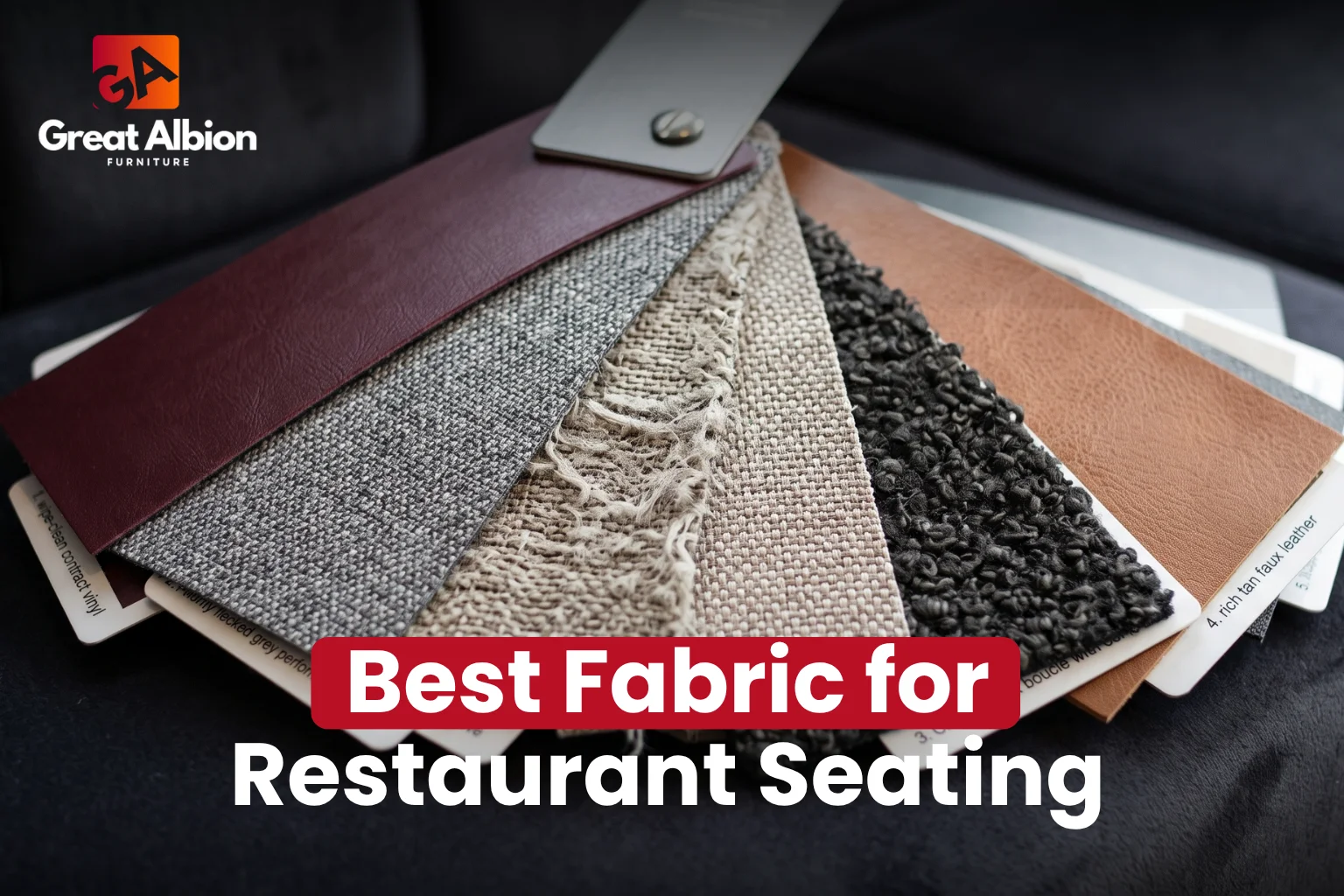
Six materials cover almost every specification. The best fabric for restaurant seating in one zone is usually the wrong one in another, so read these as zone answers rather than a ranking.
Contract vinyl. The workhorse. Wipes clean, resists moisture, and handles the traffic that ends fabric. Commercial-grade vinyl typically tests at 30,000 double rubs and above, against 15,000 to 25,000 for residential grades, which is the gap that matters when someone offers you a cheap alternative. The trade-off is breathability: vinyl runs warm, which guests notice in summer and in rooms with poor ventilation.
Polyurethane and faux leather. Softer hand than vinyl with a similar cleaning profile. Better in mid-range dining rooms where vinyl reads as too utilitarian. Generally less durable than a good contract vinyl at the same price.
Performance textiles. Engineered synthetics with stain and moisture barriers built into the fibre rather than applied as a topcoat. These are the answer where you want the look and feel of fabric with something close to the cleanability of vinyl. They cost more and they are worth it in dining rooms, not in bars.
Wool and wool blends. Naturally durable and flame-resistant, with a quality that synthetics do not replicate. Suits hotel lounges and fine dining. Not a food-service fabric, because it stains and it does not wipe.
Leather. Durable, wipeable and ages well. Expensive, and it marks. Best used on backs and accent pieces rather than seat pads that take the daily wear.
Marine-grade vinyl. For outdoor and terrace seating, built for moisture and UV. Specify it for anything that lives outside rather than assuming standard contract vinyl will cope.
Cleaning codes and what they cost you
Every upholstery fabric carries a cleaning code, and it determines your running cost more than the purchase price does.
- W — clean with water-based cleaners. Staff can do it with what is already behind the bar.
- S — clean with solvent-based cleaners. Requires specific chemicals and, often, training.
- W/S — either works.
Specify W or W/S wherever staff will be doing the cleaning, which is almost everywhere in hospitality. An S-code fabric in a busy dining room means either a specialist cleaning contract or a fabric that quietly stops being cleaned properly.
This is the operational cost that never appears on a furniture quote and shows up in the P&L for the next eight years.
Fabric choice and dwell time
Seating comfort is a revenue lever, not only a comfort decision.
Fast casual and high-turnover rooms benefit from firm vinyl and harder surfaces. The guest should be comfortable enough to enjoy the meal without settling in for two hours over a coffee.
Lounge and fine dining work the other way. High-density foam with performance fabric or leather extends dwell time, and longer dwell time means a second drink and a dessert.
So the fabric decision is downstream of your service model. Work out how long you want a table occupied, then specify to that. A fine-dining fabric in a fast-casual room costs you covers; a fast-casual fabric in a fine-dining room costs you spend per head.
What else to check before ordering
Fire certification. Upholstered seating in a UK venue needs Crib 5 under BS 7176, and the fabric is only part of that: the certification applies to the finished composite of fabric, foam and interliner. Our Crib 5 fire regulations guide covers what to ask a supplier for.
Foam density. Rub count measures the surface. Nothing measures the foam, and collapsed foam ends more seats than worn fabric does. Ask for the density figure and the warranty term on it.
Seat versus back. These wear at different rates. Specifying a heavier fabric on seats and a lighter one on backs is standard practice on banquettes and saves money without shortening service life.
Colourfastness. A fabric that tests brilliantly for abrasion can still fade in a window seat. Ask for the lightfastness rating separately, especially for terraces and conservatories.
Re-upholstery. Banquettes get re-covered rather than replaced. Choose a fabric that will still be available in three years, or accept that a repair means recovering the whole run.
Choosing the best fabric for restaurant seating by zone
- Bar and stool seating: contract vinyl, 60,000 Martindale, W or W/S code
- Fast casual dining: contract vinyl or firm PU, 40,000 minimum
- Casual dining room: performance textile, 40,000 minimum
- Fine dining: performance textile, wool blend or leather with high-density foam
- Hotel lounge: wool blend or leather, lower traffic tolerates it
- Terrace and outdoor: marine-grade vinyl with a lightfastness rating
Great Albion Furniture supplies contract seating to UK venues with commercial upholstery and appropriate fire certification. Browse our restaurant chairs and café chairs, or ask for the specification sheet on any range.
Frequently asked questions
What Martindale rating do I need for restaurant seating?
At least 40,000 cycles for a dining room and 60,000 or above for bars, stools and high-traffic areas. Below 40,000 is domestic or light contract specification and will not last in a commercial setting.
Is Martindale the same as double rubs?
No. Martindale measures cycles under the European test method; double rubs come from the North American Wyzenbeek test. The two scales are not interchangeable and there is no reliable conversion, so establish which test a quoted figure refers to before comparing suppliers.
Is a higher rub count always better?
No. The Association for Contract Textiles states that figures above 100,000 do not provide meaningful additional value, because the fabric stops being the component that fails. Compare cleanability, colourfastness and seam construction instead.
Is vinyl or fabric better for restaurant seating?
Vinyl for high-turnover, wet-led and outdoor settings, because it wipes clean and resists moisture. Performance textiles for dining rooms where comfort and appearance matter and spills get dealt with quickly. Most venues use both, zoned by room.
Does the fabric need to be Crib 5 certified on its own?
The certification applies to the finished composite of fabric, foam and interliner rather than the fabric alone. Ask your supplier for certification on the assembled seat, not a fabric test report.
About the author
Written by the Great Albion Furniture team. Great Albion Furniture supplies commercial furniture to restaurants, cafés, hotels and hospitality venues across the United Kingdom.