Banqueting Table Sizes and Seating Capacity: A UK Buyer’s Guide
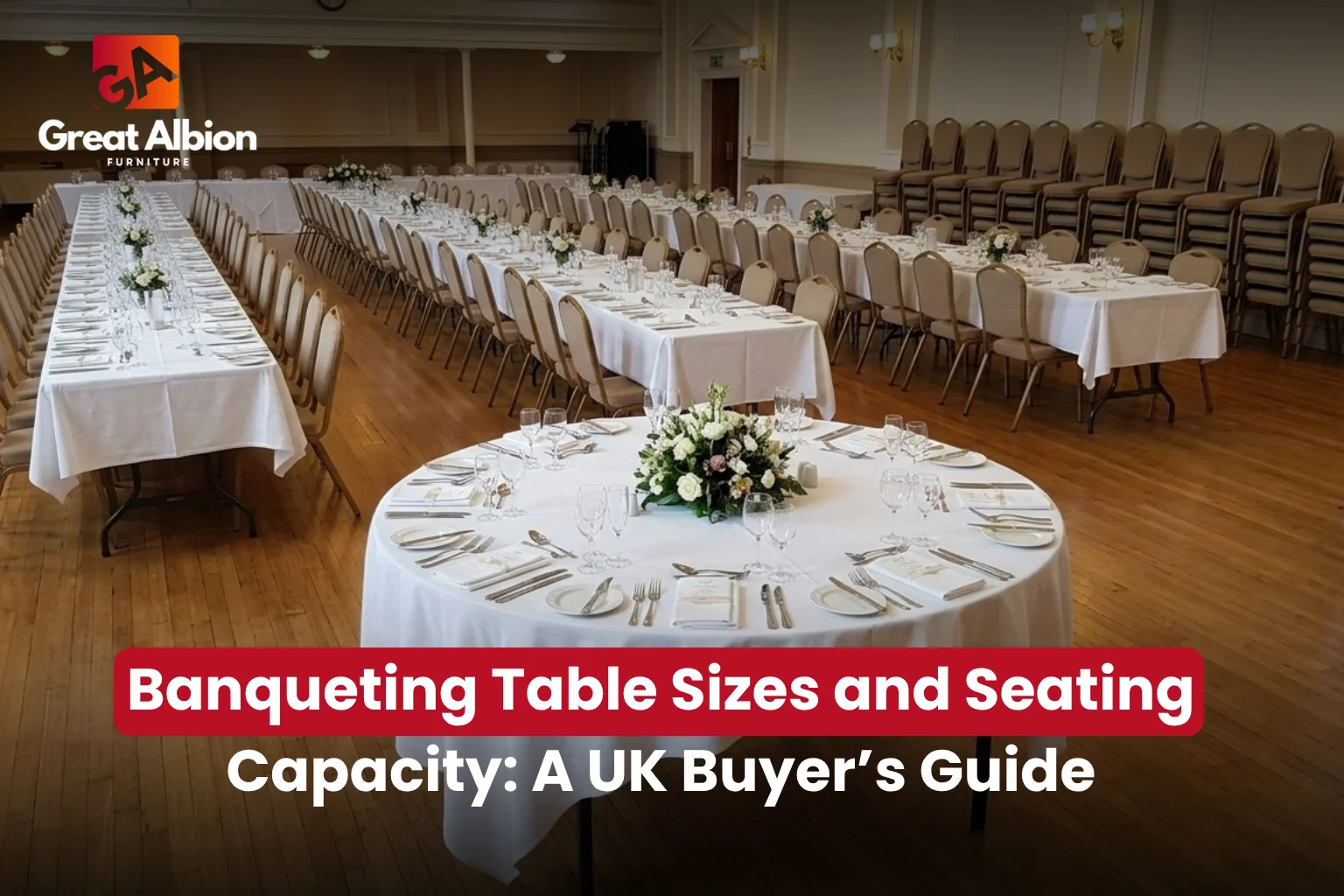
A 6ft rectangular banqueting table measures 183cm x 76cm and seats six to eight. A 6ft round measures 180–183cm across and seats eight to twelve. Most banqueting table sizes in the UK are still quoted in feet, and the seating figure you see advertised assumes no side plates and narrow chairs.
Last updated: September 2026
Table of contents
- What are the standard banqueting table sizes?
- How many people fit at each size?
- What height should a banqueting table be?
- Round or rectangular: which should a venue buy?
- How much floor space each table needs
- Table top materials compared
- Legs, locking mechanisms and what fails first
- Do banqueting tables need Crib 5?
- How many tables does a venue actually need?
- Choosing banqueting table sizes for your venue
What are the standard banqueting table sizes?
UK banqueting tables come in two families: rectangular trestles and rounds. Both are sold in imperial sizes even though the specifications are metric, a hangover the events trade has never dropped. Table and linen sizes across England, Wales and Scotland are still quoted in inches for exactly this reason.
Here are the banqueting table dimensions you will actually be quoted on:
| Size | Metric | Shape | Typical seating |
|---|---|---|---|
| 4ft | 122cm x 76cm | Rectangular | 4 |
| 5ft | 152cm x 76cm | Rectangular | 4–6 |
| 6ft | 183cm x 76cm | Rectangular | 6–8 |
| 6ft narrow | 183cm x 60cm | Rectangular | 6 |
| 8ft | 244cm x 76cm | Rectangular | 8–10 |
| 3ft round | 91cm diameter | Round | 2–4 |
| 4ft round | 122cm diameter | Round | 6–8 |
| 5ft round | 152–160cm diameter | Round | 8–10 |
| 6ft round | 180–183cm diameter | Round | 10–12 |
Of all the banqueting table sizes listed, the 6ft rectangular and the 5ft round are what most UK venues buy in volume. The rest are supporting sizes.
One detail buyers miss: the 6ft rectangular comes in three widths, 183cm x 60cm, 183cm x 76cm and 183cm x 92cm, and they are sold as separate products. The 60cm version suits conference rows and buffet lines. Put dinner service on it and there is no room for a centrepiece.
How many people fit at each size?
Published seating figures disagree, and the disagreement is not sloppiness. It reflects two different assumptions.
Event hire companies commonly apply a rule of two feet (61cm) per person along the table length, which puts three on each side of a 6ft rectangular and six in total. Many suppliers quote six to eight for the same table, because they are counting the two end seats and allowing tighter spacing.
Rounds show the same split. Manufacturer listings commonly put a 6ft round at ten to twelve, while event planners working to a full cover often plan six to eight per round.
The higher number is absolute capacity with narrow stacking chairs and no side plates. The lower number is comfortable capacity with a full cover and upholstered chairs.
Plan on the lower figure. Trestle table seating capacity quoted at the top of the range assumes conditions your service probably will not match. A wedding with a three-course plated menu needs the low number. A conference with water glasses and notepads can run the high one.
Chair width is the variable nobody prints. A 45cm stacking chair and a 52cm upholstered banquet chair change the answer by one guest per side on a 6ft table. Measure your chairs before counting covers. Our guide to choosing banquet chairs covers the widths to look for.
What height should a banqueting table be?
Standard banqueting table height is not the same as standard dining table height, and the gap is enough to matter.
UK dining tables sit at 75–76cm. Banqueting tables often sit lower: folding ranges on the UK market are supplied at 72cm, 73.5cm or 76cm depending on the model.
That is a 4cm spread on a category that looks standardised. Buy at 72cm, pair with chairs designed around a 76cm table, and guests sit higher relative to the surface than they should. It reads as a comfort problem rather than a specification problem, so it gets blamed on the chairs.
Check the height on the datasheet before ordering, against the seat height of the chairs you own. Around 25–30cm of clearance between seat top and table underside is the working range for adults. Ordering tables and chairs together resolves this. Replacing tables into existing chair stock does not.
Round or rectangular: which should a venue buy?
For a venue buying its first set, buy rectangular. Round is the upgrade, not the default.
Rectangular tables butt together into long runs, U-shapes and classroom rows. One size covers dining, conferences, exam halls, buffets and registration desks. Rounds do one thing: seated dining in banquet or cabaret layout.
Rounds win on guest experience. A table of ten in a circle produces conversation across the whole table; a run of trestles produces conversation with the two people beside you. For weddings and awards dinners, that difference is the product you are selling.
The practical answer for most function rooms is a core stock of 6ft rectangulars plus enough 5ft rounds to run your largest banquet layout. Treating round vs rectangular banqueting tables as an either-or is what leaves venues turning down bookings.
How much floor space each table needs
Capacity is set by the room, not the table. Allow 90–100cm of clearance behind each seated chair so a guest can stand and leave, and a service lane of at least 120cm between table groups where staff carry plates.
On those figures, a 6ft round seating ten occupies roughly 3.7m x 3.7m including its chair ring. A 6ft rectangular seating six occupies about 3.6m x 2.6m. Per cover, rounds are less efficient, which is why conference and exam layouts are almost always rectangular.
These are furniture planning figures. Licensed capacity, fire exit widths and evacuation routes take priority. Your fire risk assessment sets the ceiling, not your table count.
Table top materials compared
Four materials dominate, and they are not interchangeable.
Exterior grade plywood. The contract standard for wooden trestles, typically an 18–19.5mm top with several coats of varnish and PVC edge banding. Heavy, durable, repairable.
Laminate on MDF or chipboard. Wipe-clean and available in oak, walnut, beech and gloss finishes. Lighter and cheaper than plywood. The face is durable; the edge is the weak point, which is the same failure we cover in our guide to MDF table tops.
HDPE (blow-moulded plastic). Weatherproof, light, and the choice for outdoor and marquee use. It will not take a hot service dish directly and looks like what it is, so most venues cloth it.
Flocked laminate. A flocked coating on round banquet tables stops tablecloths slipping and cuts noise in a busy dining hall. Worth specifying if you run large plated services in a hard-surfaced room.
Weight matters more than buyers expect. A typical 6ft plywood rectangular weighs around 18–19kg, light enough for one person to set. Heavier equivalents turn a room reset into a two-person job and add labour cost to every event.
Legs, locking mechanisms and what fails first
Tops rarely fail first. Legs and locks do.
Look for American wishbone folding legs in powder-coated steel with an industrial locking mechanism, the standard specification on contract-grade ranges. A leg that folds without a positive lock will eventually collapse under a leaning guest.
Edge protection is the second wear point. PVC or aluminium edging takes the knocks from stacking, trolleys and doorframes. Tables without it show damage within a season.
The third is storage, and venues cause it themselves. Tables stacked with grit between the tops, or left where moisture sits under the surface, degrade faster than tables in daily service. A table trolley is not an accessory. It is what stops your stock being written off in three years.
Do banqueting tables need Crib 5?
No. Crib 5 is Ignition Source 5 in BS 5852, and it applies to upholstered furniture containing foam. A folding table with a plywood or laminate top and steel legs has nothing to test.
Your banquet chairs are a different matter. Only upholstered items containing foam can carry the certification, and BS 7176 sets Crib 5 as the medium hazard standard for non-domestic seating. If your event chairs are padded, they need it. Our Crib 5 fire regulations guide covers what documentation to ask a supplier for.
This catches out venues buying tables and chairs in one order and assuming one certificate covers both.
How many tables does a venue actually need?
Work backwards from your largest bookable layout, then add a margin.
- Take your licensed maximum capacity for the room.
- Divide by your realistic covers per table, using the lower seating figure.
- Add 10% for damage, repairs and tables out of service.
- Add your buffet, registration and top tables separately. These are not dining tables and get forgotten.
- Check the total against your storage space and trolley capacity before ordering.
Step five is where orders go wrong. Venues size to the room, then find the store cupboard holds two thirds of it.
Choosing banqueting table sizes for your venue
The default set of banqueting table sizes for a UK function room: 6ft rectangulars as core stock, 5ft or 6ft rounds for banquet layouts, and a few 4ft rectangulars for registration and buffet duty. Confirm the height matches your existing chairs, the top material suits indoor or outdoor use, and the legs lock positively.
Then buy the trolley in the same order.
Great Albion Furniture supplies contract-grade tables and seating to restaurants, cafés, hotels and function venues across the UK. Browse our catering tables and stacking banquet chairs to see sizes, finishes and specifications in full.
Frequently asked questions
What is the difference between a trestle table and a banqueting table?
In UK trade use they are the same product. “Trestle” describes the folding leg construction, “banqueting” the application. Suppliers list identical tables under both terms, plus “catering table” and “folding table”. Search all four when comparing quotes, because prices differ by listing.
Can banqueting tables be used outdoors?
HDPE-topped tables are built for it. Plywood and laminate tops are not: moisture penetrates the edge banding and the core swells, and one wet event can end a table. If you run marquees or outdoor catering, buy HDPE for that stock and keep it separate from your indoor set.
How much weight can a folding banqueting table hold?
Contract-grade folding tables are commonly rated between 150kg and 180kg distributed load, based on manufacturer specifications for heavy-duty models. Distributed is the operative word. A rating covers a full buffet spread, not a person standing in the middle to hang decorations.
What size tablecloth fits a 6ft banqueting table?
For a 183cm x 76cm table at 76cm high, a 90in x 156in cloth gives a full drop to the floor. Round sizing works the same way: measure the diameter, add twice the height for a floor-length drop, and less for a lap drop.
Are folding tables suitable for permanent restaurant use?
No. Folding tables are built for rooms that change layout. For fixed covers, a table base and top assembly is more stable, looks better uncovered and lasts longer under daily service. Our guide to commercial table bases covers the options.
About the author
Written by the Great Albion Furniture team. Great Albion Furniture supplies commercial furniture to restaurants, cafés, hotels and hospitality venues across the United Kingdom.